
The God I Do Believe In
By Martin Thielen
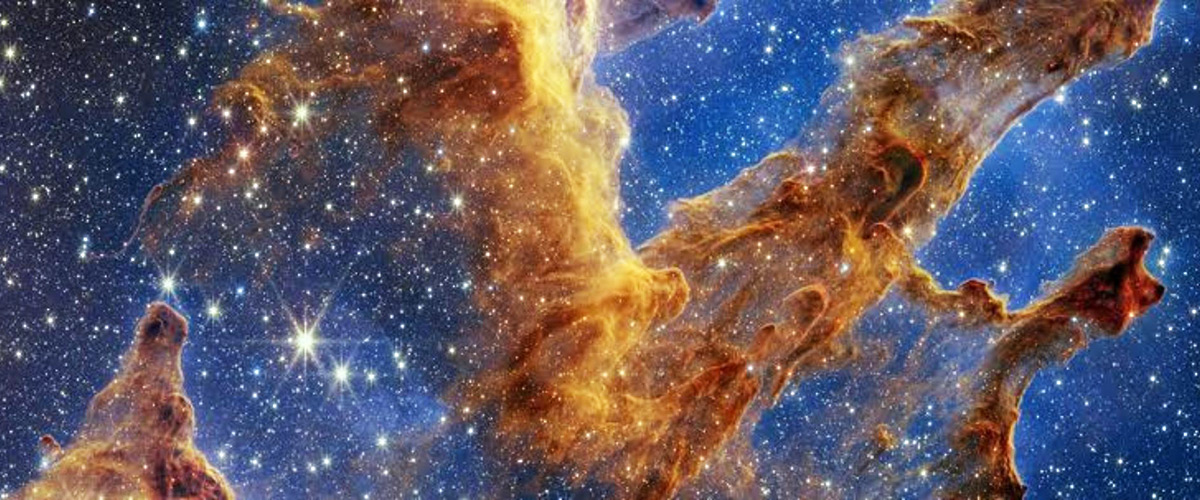
The Pillars of Creation – James Webb space telescope – NASA image
December 2, 2025
[NOTE: This article is a follow-up to last month’s post, The God I Don’t Believe In.]
I majored in religion at college. One semester I took a class called Christian Doctrine. I still remember the final exam. The professor wrote it on the blackboard. It consisted of five words. “Describe the nature of God.”
I took a deep breath, pulled my pen out of my shirt pocket, and opened up my “blue book.” (For younger readers, a blue book is a little blank book with about twenty lined pages that college students used to use for answering long, open-ended, essay exams.) I began writing furiously about the nature of God and didn’t stop for an hour. I just about filled up the entire blue book. And I aced the test. The professor gave me an A+ and wrote, “Well done, Martin.”
Shoebox Theology
I could not replicate that essay today. At age sixty-eight, I know far less about God than I did at age twenty. Instead, I resonate with Barbara Brown Taylor’s comments in Leaving Church, “I cannot say for sure when my reliable ideas about God began to slip away, but the big chest I used to keep them in is smaller than a shoebox now.” The only difference between her and me is that I would change “shoebox” to “matchbox.” Rather than needing a twenty-page blue book, I could describe what I know about “the nature of God” in a short text.
Most Christians across the globe still affirm belief in a personal, all-powerful God who providentially cares for the world, supernaturally intervenes, answers prayers, and performs miracles. In short, most people of faith still affirm classic theism. And I respect people who hold this orthodox historic view. I did for many years, and it met many important needs in my life.
However, for me (and a growing number of others), these ancient theistic concepts about God have become impossible to believe in the modern world. In the words of the late Bishop John Shelby Spong, “The heart cannot worship what the mind cannot believe.”
After decades of doubting, grappling, thinking, and studying, I no longer believe in the God of fourth-century creeds or orthodox systematic theology. The God I believe in is far less definable and predictable. Instead of conceptualizing God as a personal, humanlike, supernatural deity, I envision God as the mysterious, creative, connective, evolutionary, intelligent, life-force, energy-force, animating Spirit of the universe. Of course, my view may not be correct. But this is where I currently find myself on the spiritual journey. And I have a lot of company.
Backstroking Into the Unknowable
Affirming a nontheistic God requires a great deal of theological modesty. As a Doubter’s Parish reader once said to me, affirming this nontraditional view of God is like “backstroking into the unknowable.” Absolute certainty and clarity are not possible with this nebulous model of God. Instead, mystery and ambiguity rule the day.
Describing God as a life-force and energy-force Spirit reminds me of an old movie called Children of a Lesser God. A poignant scene in the film depicts a man joyfully listening to classical music. A deaf woman asks him to describe how music sounds. In sign language and interpretative movements he tries his best but finally gives up and says, “I cannot.”
It’s impossible to say in words and signs how music sounds. It’s also impossible to say in words or images exactly what a nonsupernatural, nontheistic God looks like. Which is one reason it appeals to me so much. As Saint Augustine once said, “If you understand it, it is not God.” And as Moses learned at a mysterious burning bush in the desert a long time ago, you can’t give God a defining and limiting name, put God in a box, and domesticate God. Instead, the life-animating Spirit of the universe self-identifies as “I am who I am.”
Back to the Future
In some ways, a modern nontheistic view of God is “going back to the future.” In the early days of humanity, people believed in a mysterious, ambiguous, animating, life-force universal Spirit. But eventually, people began to humanize this universal Spirit. So, over the centuries, they created a fertility God, a warrior God, a kingly God, a philosopher God, a father God, and ultimately a human/divine (Jesus) man/God.
Advocates of nontheistic theology believe this long-standing pattern needs to be reversed. Instead of humanizing God into our own image, they argue that we need to dehumanize God (while rehumanizing Jesus). In short, nontheists want to return to the earliest image of God as a mysterious, unifying, life-force, energy-force, animating universal Spirit.
From The Ten Commandments to Star Wars
It’s difficult to adequately describe the shift from a theistic to a nontheistic model of God. So, at the risk of massive oversimplification, let me share a movie metaphor to help make the point.
Cecil B. DeMille’s 1956 epic film, The Ten Commandments, depicts God as an all-knowing and all-powerful interventionist Deity. In this classic film God commands Moses to return to Egypt and convince the pharaoh to liberate the Hebrew people from their bondage in slavery.
As the story unfolds, God sets the Israelites free through mighty miracles, including ten plagues on the Egyptians and a dramatic parting of the Red Sea. Moses then presents the Israelites with stone tablets of God’s Ten Commandments, which must be faithfully obeyed. This traditional theistic view of a masculine and powerful God who hears prayers, works miracles, and demands obedience is still held by large numbers of believers today.
Birthed in 1977, the Star Wars film franchise has spawned more than a dozen films and other spin-offs. The Star Wars saga is far too complicated to summarize here. But a constant in the Star Wars universe is the presence of “the Force,” as in “May the Force be with you.” However, the Force is not a traditional deity or an organized religion.
The Star Wars phenomena can illustrate the growing number of people who embrace nontraditional expressions of faith. For them God is not a personal, supernatural, heavenly Father in the sky but a life-force/energy-force Spirit that permeates the universe. People who hold this view have abandoned belief in a theistic God. However, they still affirm faith in a spirituality that seeks goodness, love, and justice in the world, and they desire to engage in that noble effort.
In short, I (along with a lot of other people) have shifted from a theistic The Ten Commandments understanding of God to a nontheistic Star Wars model. This God cannot be placed in a box and fully understood. Instead, this view of God entails a lot of ambiguity and uncertainty.
Strengths of Nontheistic Theology
Every theological model has strengths and weaknesses. That’s certainly the case with a nontheistic life-force/energy-force understanding of God. I’ll review a few of them now.
On the one hand, there’s much to like about this view. For one thing, it’s believable in a modern scientific age. For growing numbers of people, belief in a traditional, personal, superhuman, interventionalist theistic God who controls the world is like believing in the Tooth Fairy, the Easter Bunny, and Santa Claus. A nontheistic view, at least for many, has intellectual viability. It feels more real, honest, and authentic to them.
Many advocates of this view appreciate its nonexclusive spirit. A nontraditional God is not limited to a specific religious tradition. People don’t have to choose between Christianity, Judaism, Islam, Hinduism, Buddhism, or a more humanist-focused faith. A nontheistic God can “work” in any religious tradition or no religious tradition. As a nontraditional Christian who still seeks to follow Jesus, it certainly works for me.
Many other positives could be added. For example, a nontheistic view of God allows people to let go of their anger at God for not providentially intervening to alleviate suffering. A nontheistic God does not and cannot intervene in the world. That’s not who a nontheistic God is or what a nontheistic God does. Instead of being a “supernatural” interventionalist God, a nontheistic God is a “super natural” God who inhabits and energizes the natural world.
A nontheistic view of God is the only reasonable solution I see to the massive theological problem of suffering. In a world of brutal and overwhelming suffering (both in the natural world and in human history), an all-loving, all-knowing, all-powerful, supernatural, interventionalist God is simply not believable for large numbers of people.
If that God existed, the world would look dramatically different than it does. Just a few nights of watching the evening news makes it crystal clear—at least to me—that a theistic God does not exist. For nontraditionalists like myself, the only viable solution to the problem of suffering (other than atheism), is to adopt a nontheistic view of God.
This theological worldview also reminds people that a traditional theistic God is not going to fix the problems of world. Instead, it’s up to us to solve pressing challenges like climate change, violence, racism, and poverty.
And the belief that a life-force Spirit engulfs and connects the entire universe together provides a moral imperative for doing so. In short, we are indeed our brothers’ and sisters’ (and planet’s) keeper. Therefore, a nontheistic view of God provides strong motivation to engage in compassionate service and social justice, which is one of its main strengths.
Weaknesses of Nontheistic Theology
Of course, a nontheistic view of God also includes weaknesses. For example, this model of God isn’t easy to explain or understand. Instead, it’s massively ambiguous, which means it will never attract a large following. People looking for definitive, black-and-white theology will not accept this model of God.
Even more problematic, large numbers of people will strongly object to this view. In short, most Christians will not make this theological shift. Asking traditional believers to jettison their core beliefs about God’s identity is too far a stretch for them.
Which reminds me of an old story about a monastery. In this story, one of the monks died, and they placed him in the large crypt where they buried all the dead monks. Three days later the monks heard noises coming from inside the crypt. When they removed the stone wall, they found their brother alive. Full of wonderment he said, “Oh brothers, I’ve been there. I’ve been to the other side. I’ve seen heaven!” Then he added, “And it’s nothing like what we’ve been taught. It’s not at all the way our theology says it is!” When he said those words, the other monks threw him back in the crypt and sealed the wall.
Most religious people don’t respond well to having their long-held beliefs questioned! And that’s especially true when it comes to beliefs about the nature of God. Asking traditional believers to jettison their core beliefs about God’s identity is too far a stretch for them. And that traditionalist view must be respected.
For example, I’m happy to share my nontheistic beliefs about God with other people. However, I’m not an evangelist for those beliefs. I don’t seek to convert people away from theism to nontheism. Instead, I help folks who are already on that journey navigate the (oftentimes) dicey transition.
Another weakness is that this view of God, at least for me, is not as emotionally satisfying as the traditional theistic view. I liked having a providential heavenly Father and a personal relationship with my best friend Jesus. I miss that kind of faith and grieve its loss. But I can no longer believe or experience it. Classical theism no longer makes sense to me. Like many others, I came to a point where I had to either redefine my understanding of God or reject God altogether. For me, having nontheistic faith is far better than having no faith.
A final problem with a nontheistic view of God is that it’s not institutionally friendly. Trying to force this view on traditional churches will bring enormous pain and conflict. It’s unfair, in my opinion, to ask congregations to jettison thousands of years of belief and tradition and embrace a dramatically different understanding about “God, the Father Almighty, maker of heaven and earth.” For the vast majority of churches, it’s too big of an ask.
Nontheistic faith can work well for individuals, including churchgoers who still find value in organized religion (in spite of its theistic theology, hymnology, and liturgy). But it’s problematic to impose this view on congregations as a whole. The one exception would be new congregations who start out with a clearly communicated nontheistic theology that members knowingly sign up for in advance.
Headed in the Right Direction
These days I enjoy reading stories to my grandchildren. One of my favorite children’s books is E. B. White’s classic tale, Stuart Little. In this story a mouselike character named Stuart goes on a great adventure, looking for his beloved friend, a bird named Margalo.
The story ends with Stuart still searching for his friend. Did he ever find her? We never find out. All we learn is that Stuart “somehow felt he was headed in the right direction.” E. B. White received a lot of grief about that ambiguous ending. He responded to the criticism by saying, “Life is essentially inconclusive.”
After a lifetime of seeking to understand the nature of God, I have come to believe that an (inconclusive) nontheistic life-force and energy-force concept of God is, in the words of Stuart Little, “headed in the right direction.” However, I’ll never know for certain if this is the best model of God for modern believers. But I’m OK with the uncertainty. In matters of faith, ambiguity goes with the territory.
###
NOTE: For additional details about my theology of a nontheistic God, along with my understanding of Jesus, Christian community, the essence of Christian faith, a critique of traditional faith, and much more, see my most recent (free) book, My Long Farewell to Traditional Religion and What Remains.
AUTHOR’S NOTE
To share this post, please click the appropriate icon at the bottom of the page. If you would like to communicate with me, feel free to send an email and I’ll respond as soon as possible. To receive my monthly newsletter (a brief email notification alerting you to new posts and other materials), please do so today. Thank you for your interest in Doubter’s Parish. Writing for you is a joy.