
Seven Strategies for Dealing with Doubt
By Martin Thielen
January 6, 2026
Those who believe they believe in God but without passion in the heart, without anguish of mind, without uncertainty, without doubt, and even at times without despair, believe only in the idea of God, and not in God himself.
—Madeleine L’Engle
In his novel The Blood of the Lamb, Peter De Vries tells the story of a struggling Dutch immigrant named Don Wanderhope. In a life chock-full of difficulty and grief, Don lost his brother, his wife, and then his daughter. Unsurprisingly, he almost lost his faith.
After the tragic death of his brother and wife, Don’s beloved daughter Carol developed leukemia. Although Don had hoped a new drug might extend her life, Carol died in the hospital on her fourteenth birthday. When he arrived at her hospital room that morning, she was already dead. Distraught, he departed the hospital and sought solace in a local bar.
While drinking, Don remembered that he left Carol’s birthday cake in her hospital room. He walked back to the room and retrieved the cake. He eventually ended up in the sanctuary of St. Catherine’s Catholic Church, a place where he often prayed for his daughter’s healing during her illness. In deep anger, doubt, and despair, Don screamed “No!” to a silent heaven. Then he took his daughter’s birthday cake and hurled it at the crucifix in the sanctuary. The scene ended with bright blue and white cake icing dripping from the face of Jesus onto the floor.
Although an extreme example, Peter De Vries’s novel vividly illustrates that people of faith often harbor serious doubts. They have doubts about God’s goodness, God’s compassion, God’s involvement in the world, and sometimes even God’s existence. In short, people of faith often grapple with doubt. What follows are seven strategies for dealing with doubt that have helped sustain me and many others.
- Expect to have doubts. An insightful person once said, “You can live a life of faith interrupted by moments of doubt. Or you can live a life of doubt interrupted by moments of faith.” Either way, doubts are inevitable. Nobody who believes in God escapes doubt. Instead, like the father with a sick child in Mark 9:24, we often cry out, “Lord, I believe; help my unbelief!” (NKJV).
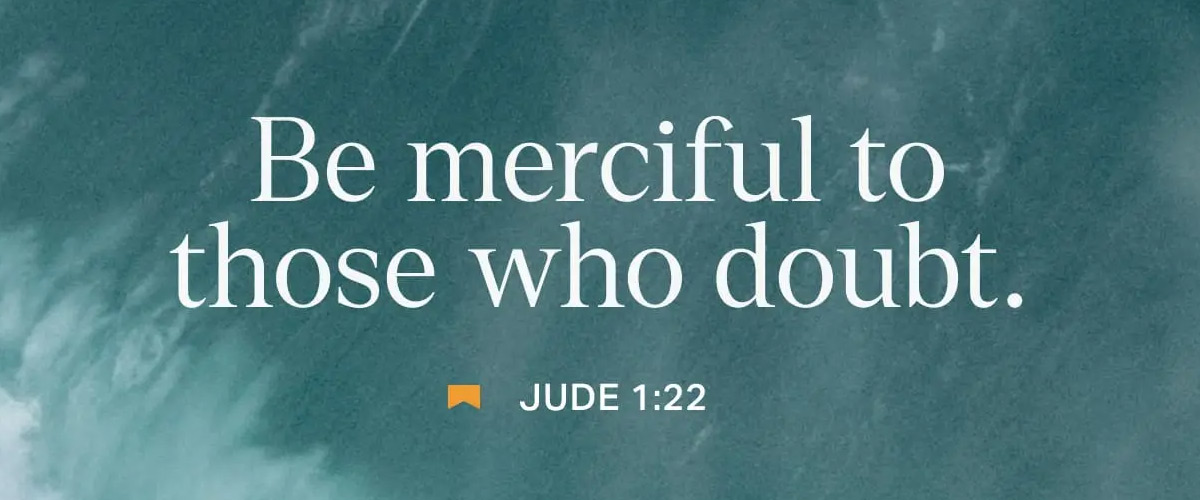
- Accept your doubts. Contrary to popular opinion, doubt is not a sin. It’s a perfectly normal part of faith. Almost every major character in the Bible and almost every significant figure in church history has, at some point, grappled with doubt. The great saint Mother Teresa struggled with it. She once wrote, “I feel that terrible pain of loss, of God not wanting me, of God not being God, of God not really existing.” Even Jesus experienced doubt as he cried out on the cross, “My God, my God, why have you forsaken me?” (Matt. 27:46 NIV). People of faith need to give themselves (and others) permission to doubt. In the words of Jude 22, let us “be merciful to those who doubt” (NIV).
- Trust your doubts. When I was a teenager, I read the Bible from cover to cover. I felt appalled by much of the content, including God’s blessing on violence, genocide, slavery, and women’s subordination. Although my church told me I must believe in biblical inerrancy and infallibility, I instinctively knew that wasn’t right. Doubting and eventually rejecting biblical literalism literally saved my faith. Years later, my doubts led me to depart the evangelical church and connect with a more progressive denomination. Doing so saved my ministerial vocation. Rather than resisting your doubts, listen to them. They have important lessons to teach you. And they might even save your faith.
- Record your doubts. One of the best strategies for dealing with doubts is to journal them. Before writing my most recent (free) book, My Long Farewell to Traditional Religion and What Remains, I read through fifty years of my journals. A significant portion of those journal entries were dedicated to recording and resolving doubts. More than any other strategy, journaling has helped me clarify and work through thorny faith issues, especially my doubts. I wholeheartedly recommend this spiritual practice to you.
- Read other doubters. Christians who grapple with doubts often think they are alone. Nothing could be further from the truth! Doubters have existed from the very beginning. Reading the thoughts and experiences of other doubters is exceptionally helpful as you work through your own doubts. I provide some specific examples in my recent articles, Reading the Heretics and The Early Heretics.
- Share your doubts. It’s important that we talk to other people about our doubts. Unfortunately, finding safe places to do so can be challenging. However, if we diligently seek them out, we can usually find a person or a group who will listen compassionately and nonjudgmentally. Even when I served in the (extremely conservative) Southern Baptist Convention, I was able to find a few kindred spirits who, like me, grappled with theological and ecclesiastical doubts. Our honest conversations helped us navigate some turbulent times. I currently belong to a group of retired progressive clergy. We share our doubts with one another all the time. That open and transparent theological comradeship is a crucial part of our faith journeys.
- Incorporate your doubts into your faith. In spite of warnings by the religious establishment, it’s OK to travel beyond the boundaries of traditional orthodoxy. Followers of Jesus have done so from the beginning of the Christian movement. After careful critique, it’s appropriate to embrace your doubts rather than discard them, allowing them to inform and expand your spiritual perspective. For example, after years of doubts, I finally admitted (to myself and others) that I no longer believed in traditional theistic theology. Instead, I now embrace a nontheistic understanding of God and have incorporated it into my theological worldview. It’s the only way I can remain a believer. In short, Christian insight didn’t end with the fourth-century creeds or canon. Instead, authentic faith continues to evolve, and our doubts help drive that evolution.
This article is predicated on the belief that faith is never absolute, black-and-white, and unwavering. According to Ann Lamott (who credits Paul Tillich), “The opposite of faith is not doubt but certainty. Certainty is missing the point entirely.”
Ann Lamott is absolutely correct. Genuine faith always includes uncertainty, questions, mystery, ambiguity, and plenty of doubts. Given that reality, I hope the above strategies will help you as you seek to navigate faith—and doubt—in the twenty-first century.
AUTHOR’S NOTE
To share this post, please click the appropriate icon at the bottom of the page. If you would like to communicate with me, feel free to send an email and I’ll respond as soon as possible. To receive my monthly newsletter (a brief email notification alerting you to new posts and other materials), please do so today. Thank you for your interest in Doubter’s Parish. Writing for you is a joy.