
Living in Anxious Times
Martin Thielen
October 27, 2026
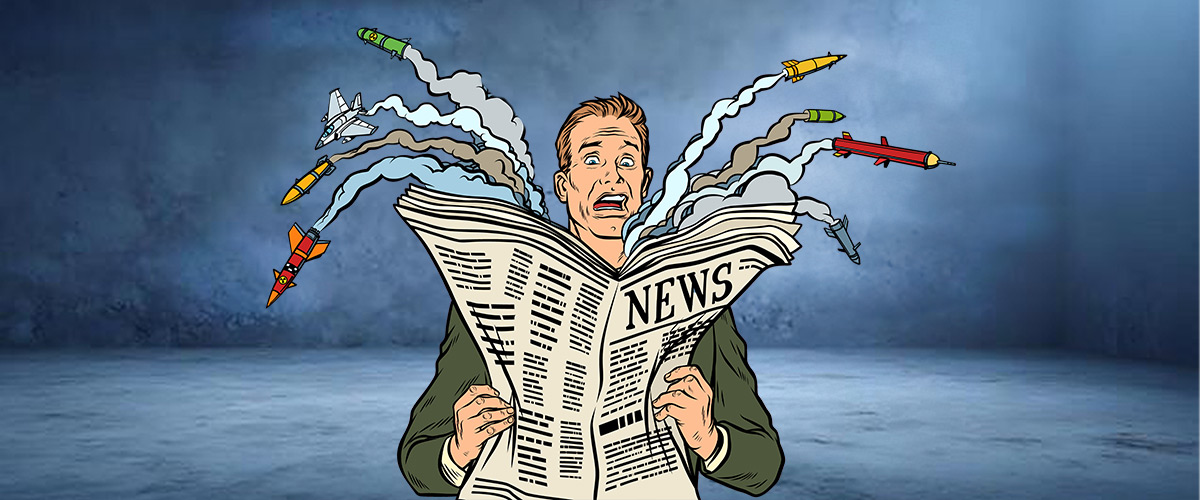
Since retiring, my favorite part of the day used to occur right after breakfast. After eating a daily bowl of oatmeal, blueberries, and walnuts, I make a cup of hot tea, sit in my recliner, and read the morning news on my iPhone as I sip on my tea.
A Scary World
However, in recent months, my “favorite part of the day” has become my “anxious part of the day.” Why? Because the news has become more and more alarming. For example, in the past few days I’ve read stories about:
- The dangers of artificial intelligence, including the possibility that it might destroy the human race.
- The ravages of climate change, resulting in relentless natural disasters which are only going to get worse.
- Wars across the globe, including Ukraine, Gaza, Iran, and beyond.
- Nervous financial markets over inflation, massive national debt, tariffs, elevated interest rates, and high oil prices.
- Severely cruel treatment of immigrants in direct violation of Scripture, including Jesus’s words, “I was a stranger and you welcomed me.”
- Growing hunger around the world, exasperated by massive cuts in USAID and SNAP (food stamp) benefits.
- Dysfunctional politics including the virtual end of bipartisan cooperation.
- Growing acceptance of white Christian nationalism, especially by evangelicals, which violates everything Jesus stood for and threatens authentic Christianity and democracy.
- The frightening influence of billionaires in U.S. politics, creating an American-style oligarchy.
- A growing crisis in health care, especially after huge cuts to Medicaid and the Affordable Care Act.
And the bad news goes on. If I wanted, I could doomscroll all day long. As a result, what used to be my favorite time of the day (hot tea and morning news) has become a time of anxiety and stress. The frightening news comes so hard and so fast that it often makes me feel immobilized. Of course, I could turn off my Apple news feed and ignore these problems. But that doesn’t seem like a viable option for a responsible world citizen or a follower of Jesus.
Two Questions I’ve Never Forgotten
A few weeks ago, as I reflected on this daily dose of anxiety, I remembered an experience from my seminary years. At the time, I was enrolled in a ten-week, four-hundred-hour summer unit of CPE (clinical pastoral education) at Central State Psychiatric Hospital in Louisville, Kentucky.
Never in my life had I witnessed such profound human suffering. The patients I served had debilitating mental illnesses that severely incapacitated them. Daily interaction with my “congregation” deeply disturbed me. I constantly dwelled on their struggles—all day at the hospital and all evening at home. This constant rumination kept me in perpetual turmoil, negatively impacted my family life, and ruined my sleep.
I finally set up an appointment with my CPE supervisor, an exceptional man named Clarence Barton. After carefully listening to my story, he asked me two questions I’ve never forgotten. His first question was, “Does all this internal turmoil you are nursing help your patients?” I answered, “No sir, it does not.” Then he asked, “Does all this inner turmoil you are nursing help you?” I said, “No, quite the opposite.” He responded, “Then why the hell are you doing it?”
My supervisor gave me a great gift that day. He taught me that I could be compassionate and empathetic in the face of trauma and suffering without becoming overwhelmed and immobilized by it. I’ve been thinking about that a lot recently.
Allowing ourselves to become overcome by the current avalanche of troubling developments doesn’t help the problems one bit. And it sure doesn’t help us. Instead, it deeply harms us. Therefore, it’s crucial that we care without becoming incapacitated.
Of course, that’s easier said than done. The daily (literally) assault on democratic and Christian values in America over the past two years feels utterly exhausting and overwhelming.
So, how can we avoid becoming crushed in spirit? Unfortunately, no simple answers exist. Those who pretend otherwise are not being honest.
I remember an old story about a young single pastor who preached a sermon called “How to Raise Children.” Years later, after he married and had two young children, he revised the sermon and called it “Suggestions for Raising Children.” Over a decade later, when his children were teenagers, he revised the sermon once again and called it “Helpful Hints for Fellow Strugglers.”
I cannot definitively tell you “How to Live in Anxious Times.” Life is more complicated than that. Simplistic formulas for dealing with today’s stressors don’t work. However, I can offer a couple of “helpful hints from a fellow struggler” for dealing with the trauma we are currently facing.
Helpful Hint 1: Do Something to Help
No one person, not even a president or pope, can make much of a dent in the challenges that threaten our world. Having humility about our limitations is important. But all of us, including ordinary people like you and me, can do our small part to help. And when you stack up all those individual efforts, it makes a cumulative difference. A few personal examples follow.
Like many of you, I’m deeply concerned about the environment, especially climate change. Unfortunately, solutions are hard to come by. And individual behavior has a limited impact. What’s needed most is bold global governmental action, which is not occurring right now, at least in the United States. Still, each one of us can make some contributions.
For me, doing my small part means driving a hybrid vehicle, replacing my gas heater with a highly efficient electric heat pump, aggressively insulating my home, keeping the temperature high in the summer and low in the winter, recycling, composting, encouraging elected leaders to protect the environment, advocating for earth care in my circle of influence, financially supporting environmental organizations, and being a member of a national environmental advocacy group. These are all small things. But if enough people did them, it would help the problem. And it would encourage elected leaders to take environmental threats more seriously.
Doing my part to help also means using my personal “platform” to advocate for a better world. Everyone has a platform, even if it’s just a few family members, friends, neighbors, coworkers, fellow church members, or Facebook contacts.
My biggest platform is my writing avocation. I maintain a well-visited website and also write for five additional publications. I use this platform to challenge bad religion and promote good religion (including advocating for the environment, compassionate immigration policy, civil rights, access to health care, and other social justice issues). I’m current in discussion with my local PBS station about doing some volunteer writing and editing for them. I don’t overestimate the impact of this writing. It’s a modest contribution. But it’s something. And everyone can do something.
Of course, these are just a few small examples. Every person, regardless of our circumstances, can help in numerous ways. We can financially support causes we believe in. We can volunteer our time in organizations that make a difference in people’s lives. We can vote and get involved politically. Opportunities to do something helpful are almost unlimited. But one way or the other, we need to be a part of the solution (even in small ways) rather than becoming immobilized by the enormity of the challenges.
In short, we should strive to live out the admonition of John Wesley (a key leader in the early Methodist movement), “Do all the good you can, by all the means you can, in all the ways you can, in all the places you can, at all the times you can, to all the people you can, as long as ever you can.” Following Wesley’s advice can help improve many of today’s problems. And it will help us as well: mentally, emotionally, relationally, and spiritually.
But activism, crucial as it is, has limits. Even when we do our best to help, it’s still easy to become burned out and discouraged. Given the relentless deluge of bad news these days, it’s difficult to avoid feelings of despair. But we must not succumb to it.
Numerous strategies can help us fight despair, including the standard suggestions like exercise, journaling, connection with family and friends, sabbath keeping, and regular breaks from social media. However, before concluding, I’d like to mention one additional (but often neglected) strategy for living in an anxious time.
Helpful Hint 2: Reclaim Some Joy
One of the most helpful antidotes to falling into despair is to reclaim some joy—in spite of all the negativity. Doing so requires us to open our eyes to the beauty all around us. If we choose to see it, we can still find massive amounts of love, kindness, compassion, empathy, goodness, laughter, honor, sacrifice, service, grace, creativity, friendship, community, and awe.
Joy can be found almost everywhere if we will take it in and celebrate it. For example, I’ve experienced joy recently by watching season four of Ted Lasso ! Intentionally reclaiming joy in our lives can help insulate us from discouragement and cynicism. For further reflections on this subject, see my previous article, Where Is the Joy?
A few weeks ago, my family and I went to a community concert in one of our city parks. People throughout our town came to the event. Goodwill prevailed among the crowd. All around the park people talked, smiled, laughed, ate popcorn from the concession stand, and clearly enjoyed themselves. Children ran through the grass laughing, playing, and chasing fireflies.
My family all sat together. During the concert I carefully watched my eight-year-old grandson. He danced to every song with joyful abandon. During one of his dances, our eyes met, and he grinned at me from ear to ear. Seeing him dance moved me deeply.
I’ve been thinking a lot about that concert over the past few weeks. I want to be like my grandson. I want—and need—to dance more. Even in these trying times. Especially in these trying times.
Now, perhaps more than ever, we need to carefully listen for the joyful music playing behind all the noise around us and dance a bit. May that be true in your life. And in mine. Amen.
AUTHOR’S NOTE
To share this post, please click the appropriate icon at the bottom of the page. If you would like to communicate with me, feel free to send an email and I’ll respond as soon as possible. To receive my monthly newsletter (a brief email notification alerting you to new posts and other materials), please do so today. Thank you for your interest in Doubter’s Parish. Writing for you is a joy.
Martin Thielen, a retired United Methodist minister, former megachurch pastor, and best-selling author, is the founder and author of Doubter’s Parish.